 |
 |
 |
 |


|
|
|

|
William Friedkin: |
 |
|
1. The Intensity of William Friedkin (2002 Melbourne report)
In
William Friedkin’s erotic thriller Jade (1995), Linda Fiorentino plays a psychology
professor who specialises in the topic of “hysterical blindness”. She explains
to her students that those who are in the grip of this condition are liable to
commit unspeakably violent and perverse acts, because they are “blind to the
darkness within”.
Hysteria
and the darkness within are familiar states in Friedkin’s films. From the
claustrophobic rendition of Harold Pinter’s The Birthday Party (1968) and the all-out Satanic
horror of The Exorcist (1973) to the kinky, leather underworld of Cruising (1980) and the disquieting path of a serial killer in Rampage (1992), the director has often set out to shake and disturb
his audience.
Yet,
when asked by an audience member at a packed special Melbourne screening about
this predilection for the dark side, Friedkin played down the too-easy
association of his personality with his work. He conceded that “the dark side
has served dramatists well”. But what drives him, as he made clear, is not
primarily an intellectual interest in the morality of evil, but an attraction
to the intensity that is offered by pure film.
In
truth, Friedkin has made many kinds of movies. There are comedies like Good Times (1967) with Sonny and Cher,
the true-life crime caper The Brink’s Job (1978) and the satire Deal of the Century (1983). His underrated sports movie Blue
Chips (1994) generates an infectiously vulgar energy, embodied in the
splendid performance by Nick Nolte.
Pure
film for Friedkin covers far more than the jolts provided by horror movies or
thrillers – genres in which he has excelled. As he told the Melbourne crowd,
his love for staging car chase scenes, evident in his classic The French Connection (1971), came from
admiring silent Buster Keaton comedies.
Time
has put Friedkin’s career into an intriguing and paradoxical perspective. In
the '70s, he was perceived as an innovative, cutting-edge, modernist director.
The barrage of sights and sounds in The Exorcist,
often deliberately hard to make out clearly, forged a link between Hollywood
genres and the more arcane realms of experimental cinema.
Cruising, which I regard as a masterpiece of
the ‘80s, takes Friedkin’s style to the furthest reaches of disorientation and
ambiguity. In this mystery about a serial killer in the gay scene, Friedkin
systematically confuses every variable of the culprit’s identity, including his
body shape and voice tone. Inevitably, the cop (Al Pacino) who goes undercover
to crack the case becomes psychologically contaminated by all this
shape-shifting frenzy.
In
his films of shock and dread, Friedkin has pursued many remarkable stylistic
explorations. His favourite part of the filmmaking process is editing, and it
shows. He is a master of the abrupt cut which whisks away a scene at its
emotional height, leaving the audience momentarily perplexed as to its outcome.
Visually,
he is a prodigiously inventive filmmaker. His determination to “never use the
same shot twice”, which completely goes against the grain of standardised
Hollywood production methods, was derived from viewing the art movies of
Michelangelo Antonioni.
Less
well recognised is Friedkin’s highly developed feeling for film sound. During
his session in Melbourne he confided that he likes to edit to the accompaniment
of music by the Australian band The Necks, and charmingly paused at one point
to appreciate the soft sound of rain falling on the cinema’s roof.
Sound
effects and musical tracks are put through their paces in Friedkin’s films. The
composer Jack Nitzsche, when he appeared at Melbourne’s Cinesonic conference shortly before his death in 2000, recalled the
director’s penchant for “stacking” – running several pieces of music at the
same time. It was disconcerting, Nitzsche said, but it worked.
It
is little wonder, with all these rampant ambiguities and assaults on the
spectator, that the influential critic Robin Wood came to regard Friedkin in
the '80s as a prime example of a filmmaker devoted to manufacturing “incoherent
texts”. An equivocal Wood commented of Cruising that “its surface is deliberately fractured, the progress of the narrative
obscured, in a way that one must recognise as extremely audacious within the
Hollywood context, though not necessarily artistically successful”.
However,
judgments of Friedkin’s artistic success must take account of another aspect of
his career. From today’s vantage point, the director’s work appears equally
classical and modernist. This is doubtless a legacy of his early, prodigious
work in live television drama, recalled in his version of Twelve Angry Men (1997).
Amidst
the flurry of wild effects and experiments, Friedkin has always shown a sure
grasp of dramatic construction. Outside of the horror genre, the theme of the
‘darkness within’ modulates into a complex portrait of ethical binds and moral
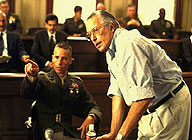
contradictions. Even in the military saga Rules of Engagement (2000), one of his lesser
works, he was able to cut through the ideological cant and reveal some
intriguing, underlying issues.
When
asked in Melbourne which single scene in his career he had lavished the most
painstaking attention on, Friedkin’s answer was surprising. It is a seemingly
simple dialogue scene in The Exorcist between Lee J. Cobb and Ellen Burstyn, bristling with the subtext of facts
unspoken and complicit understandings. “I choreographed it like a dance”,
Friedkin declared, down to the smallest gesture of a hand on a teacup. The
scene also reminds us what a fine director of actors Friedkin can be.
Friedkin
came to Australia for the re-release of Sorcerer (1977), a film that has barely been seen locally, and only in a brutally
truncated version. He regards this remake of Henri-Georges Clouzot’s The Wages of Fear (1952) as his personal
favourite. It stands at the crossroads of his filmmaking trajectory, mixing
gritty, downbeat realism with heightened action scenes, and an acute sense of
world politics with some woolly, old-fashioned, pseudo-existentialist notion of
‘man’s fate’.
It
has some extraordinary sequences, especially when trucks loaded with
nitro-glycerine inch their way across flimsy bridges. I suspect that George Mad Max Miller may have mined Sorcerer for
its striking imagery of vehicles as living beasts, and its association of a
dying man with a spluttering truck. As always in Friedkin, the wall of sound
(rain, engines, human cries) is overwhelming, and
carefully integrated with the synthesised score by Tangerine Dream. And of all
Friedkin’s movies it is the one most deeply plunged into the richness, variety
and terror of the natural world, its landscapes and environments.
But,
for once, pure film tends to obliterate the possibility of our interest in the
characters and their personal stories. Friedkin today rues the fact that he
missed out on casting Steve McQueen in the role played by Roy Scheider. “Now I
know that a strong close-up is worth more than any landscape”, he comments,
sensing that true star power in the Old Hollywood sense may have provided a
dramatic core to the project.
Still, Sorcerer serves as another salutary tribute to the spirit of American cinema in the ‘70s, and a reminder of the possibilities that have since been foreclosed in a more corporate industry. Even the suspended, open ending which at the time seemed an obligatory ‘70s cliché now packs a wallop. William Friedkin knows the score: “You couldn’t get away with that ending today”.
2. Shock Tactics: William Friedkin 1935-2023 (obituary tribute) In William Friedkin’s 1968 film of Harold Pinter’s classic 1957 play The Birthday Party, a seemingly playful moment (inspired by the author’s own text and staging instructions) turns threatening – and extremely cinematic. Meg (Dandy Nichols) offers her sullen houseguest, Stanley (Robert Shaw), a child’s drum as a birthday present. He stands up and parades around the room with it, beating a military rhythm. But when he reaches Meg, Stanley’s drumming becomes manic and insistent; he appears to be attacking her. Friedkin, who has already amplified the drum sound in post-sync, adds a further, disorienting touch: at the intense height of the scene, he cuts, for several seconds, to blackness and silence. When the image returns, the story picks up at a later point, and the incident with the drum is never again mentioned. Friedkin’s entire approach to filmmaking is encapsulated in the black hole punched in that scene. Shock, surprise, confusion: these are the states he wanted the spectators of his films to inhabit, as often and as powerfully as possible. Little wonder, then, that he became a specialist in the popular genres of horror, thriller and action. At the same time, his attachment to The Birthday Party – “a revelation as pivotal as Citizen Kane” when he saw it on stage in Chicago in 1962 – indicates his deep respect for a certain strain of so-called high culture. Throughout his career, he returned to adapting famous plays for the screen, such as Reginald Wells’ Twelve Angry Men in 1997, and, completed shortly before his death, a modernised version of Herman Wouk’s The Caine Mutiny Court-Martial (2023). Relatively late in his life, he also became a prolific director of operas in USA and Europe. In a crucial sense, however, Friedkin made no distinction between these various shades of high and low culture. “What I still want from a film – or a play, a painting, a novel, a piece of music”, he wrote in his 2013 memoir The Friedkin Connection, “is exhilaration. I want to be moved and surprised at some revelation about the human condition.” Friedkin’s path as a filmmaker began as an orchestrator of live TV shows in the early 1960s, and quickly found independent expression in the hard-hitting documentary The People vs. Paul Crump (1962), which mixed interviews with dramatic recreations reminiscent of John Cassavetes’ Shadows (1959). His first features, the painfully zany pop musical Good Times (1967) with Sonny and Cher, and the comedy The Night They Raided Minsky’s (1968), gave little indication of what he would later achieve. It was The Birthday Party and the gay-themed The Boys in the Band (1970), adapted from Mart Crowley’s play, that placed him on surer creative footing. The taste for shock transitions – and the lingering mysteries they can create – are evident everywhere in Friedkin’s two most commercially successful films, The French Connection (1971) and The Exorcist (1973), both based on true cases. The conclusion of the former – an image of the unconventional cop Popeye (Gene Hackman) running offscreen, followed by the sound of a gunshot and a cut to black – left many viewers puzzled, but that is exactly what Friedkin wanted. The Exorcist is a remarkably elliptical film: over and again, it builds to a terrifying crescendo and then simply cuts away to a new scene. In this fusion of content and form, Friedkin took the horror genre even further into bold experimentation than Dario Argento, Mario Bava and other giallo filmmakers had previously done. Both The French Connection and The Exorcist could be rhetorically described as epoch-defining films. But Friedkin himself was not particularly nostalgic over the much-vaunted era of 1970s American cinema, with its short-lived burst of freedom for filmmakers. And neither, as spectators and critics, should we seek to lock Friedkin up in the mythologised memory of that period. He was someone who was determined to move with the times, constantly renewing himself. Friedkin may have imagined himself as sitting awkwardly between two distinct generations of American filmmakers. He was too young to have been part of the live TV drama generation (which he greatly admired) comprising Sidney Lumet, Arthur Penn and John Frankenheimer (who took the French Connection II gig in 1975); and he was slightly displaced from the gang acclaimed as 1970s mavericks including Martin Scorsese, Francis Ford Coppola and Brian De Palma. But his in-between status ultimately served him well as an artist. Although he tried his hand (as did Robert Altman) at a bit of everything along the way – theatre, music videos (for Laura Branigan and Barbra Streisand), TV series episodes (CSI), a return to personal documentary (The Devil and Father Amorth, 2017) – Friedkin’s sensibility had a solid, dual foundation. He combined the classical storytelling strengths of 1950s American cinema with a taste for modernism derived from the Nouvelle Vague and other art film movements of the ‘60s. Friedkin was painfully aware that his early smash successes set a benchmark that, in purely industrial terms, he never again equalled. He joked that the remainder of his career was an “uphill climb to the bottom”. Cinephiles, of course, know better: To Live and Die in L.A. (1985) and Blue Chips (1994) are works of remarkable energy and inventiveness. Furthermore, his films are being steadily reappraised: Sorcerer (1977) and Cruising (1980) are far more respected today than on their initial release. Friedkin, whenever possible, helped his back-catalogue along with ‘director’s cut’ re-releases (some unwise remastering decisions included, it must be said) and in-depth masterclasses in many parts of the world. Even a seeming misstep such as The Guardian (1990) – mercilessly derided in its day and omitted altogether from Friedkin’s memoir – is worth revisiting as a smart precursor to the current folk/eco-horror revival. The disquieting Rampage (1987) turns out, similarly, to be prophetic of the 21st century true crime obsession: this tale, largely set in a courtroom, ‘tunes in’ to the mind of a serial killer (played by Alex McArthur) so uncannily that, at moments, it almost appears to offer a sympathetic apologia for his nihilistic acts. As was the case for several of the filmmakers who came to prominence in the ‘70s, Friedkin tended to stumble only in the realm of outright comedy, such as the brittle Deal of the Century (1983). Even in this vein, however, the films repay a fresh look. The Brink’s Job (1978), for example, comes to life the darker and more melancholic it becomes – when the unlikely success of a group of amateur crims (its high-spirited, heist-procedural half, with a nod to the universe of Cassavetes in the acting of Peter Falk and Gena Rowlands) inexorably turns toward failure, isolation and mutual betrayal. Friedkin had some unusual ways of working. Like De Palma (but unlike, say, Monte Hellman, Ulu Grosbard or Alan Rudolph), he always pre-defined clear set-piece scenes (chases, confrontations, revelations, sex scenes) – detachable and anthological by their very nature. Pre-production constituted a particularly intense creative stage. Extensive scouting of locations, absorption in many types of music, and an insistent involvement in successive drafts of the script were all means of bringing the subject and material closer to his creative core. In the end, his films are less purifications emerging at the end of this pre-production process (as would be the case for many directors) than palimpsests, layerings of diverse inputs, themes, points of interests – all evident on the heavily textured and patterned surface of the work, but not necessarily forming a tidy, organic, ultimate sense as the film’s ‘vanishing point’ in the mind of the spectator. American critic Bill Krohn has documented how no successive draft of Cruising, no option entertained in the crafting of its mystery, ever entirely left the work table; the script became a collage of possible interpretations, giving the film its enduring, sometimes frankly bewildering richness. During shooting, Friedkin could be a difficult, demanding person. His memoir shamefully confesses that, for the action scenes in The French Connection, “I put people’s lives at risk … no film is worth it.” Of the same film, he recounts that the only way he could arouse Hackman into performing the necessary level of anger was to literally make him angry – with the bad vibes on set serving to enhance the character on screen. The Friedkin Connection draws a discreet veil over much of the director’s private life (including his two-year marriage to Jeanne Moreau), indicating only that he often neglected close relationships for the sake of his driven obsession with work. Many of Friedkin’s movies were fractured in a modernist manner. That’s captured in his favoured method of literally stacking diverse music tracks simultaneously in the sound mix (much to the surprise of his canny music collaborator, Jack Nitzsche); in the multiplication of preludes to the main storyline of The Exorcist (which Bernard Herrmann, who was briefly courted to compose a score, irritatedly told him to cut); or the long, dazzling montage, leaping far ahead into the plot, that opens To Live and Die in L.A. – which the director candidly described as comprising “random shots I had no idea I would use until I got into the cutting room and their usefulness was revealed”. Robin Wood suggestively proposed that Cruising was an incoherent text, and that this incoherence was symptomatic of its time and culture; what he overlooked was the hint that Friedkin, all along, was in the business of deliberately manufacturing incoherence. Underneath the shock tactics, however, Friedkin’s dearest themes are evident. To paraphrase French critic Jean-François Tarnowski, whose study of the superb chase scene in To Live and Die in L.A. Friedkin regarded as “definitive”: hero and villain constantly switch places; and the assumed goodness of the hero is, from the very beginning, put in question. From The French Connection and The Exorcist to Jade (1995) and The Hunted (2003), these qualities of ambiguity and reversal hold firm. Or, as Friedkin himself reflected, the “themes that continue to haunt me” are “guilt, obsession, the breakdown of social order, a man’s inner conflict over his own actions.” He was not a storyteller into dramatic or cathartic reassuring solutions, when one audience member personally confronted him, after a screening of Killer Joe (2011), with her plaintive question “Where is the redemption?”, Friedkin solemnly replied: “There is none”. The Caine Mutiny Court-Martial gives us a sturdy expression of Friedkin’s classical side. Referring back to the era of live TV drama (as well as to his own Rules of Engagement, 2000), it is a study of human psychology under the pressure of both a closed space – a military courtroom – and a compressed time frame. Friedkin’s tight mise en scène and his collaboration with actors has never been better showcased. There is even a final, table-turning dramatic reversal at the very end which allows Friedkin to find, one last time, an opportunity for a strong, sudden cut to black before the credits roll. But Friedkin had already made what can be considered his swan song – and it was a one-two punch. In the new century, Friedkin’s career reached a new plateau of excellence – partly due to the writer (and sometime actor) Tracy Letts. Bug (2006) and, five years later, Killer Joe, adapted by Letts from his plays, allowed the director an extraordinary opportunity to discover for himself what the cultural critic Edward Said described as a late style common to some artists in their older age. Late style is not about the achievement of serenity and wisdom; rather, it marks the moment when a creator goes for broke, no longer concerned with compromise, unafraid to push boundaries or to offend. Which is to say, in Friedkin’s case, that he proved himself, in these masterpieces, absolutely faithful to the most radical impulses of his youth – but with these impulses now married to the most exacting and precise craft. Where Bug is hallucinatory in its immersive vision of a folie à deux (brilliantly embodied by Ashley Judd and Michael Shannon), Killer Joe allows a more objective look at a sordid milieu of abuse and domination. Friedkin concludes it with a suitably outrageous gesture – one only he could have devised. As the confrontations between the characters reach their violent apex, Dottie (Juno Temple) halts everything with the sudden announcement that she’s pregnant. That’s the cue for a song to play over the final credits: Clarence Carter’s bawdy 1986 rock-soul classic “Strokin’” – which is, basically, a celebration of fucking. Friedkin
subsequently declared that he would gladly put “Strokin’” at
the end of any film – even an adaptation of Shakespeare’s Hamlet.
That’s the kind of style – late or otherwise – we need more of
in contemporary cinema.
© Adrian Martin November 2002 / August 2023 |
