|
 |
 |
 |


|
|
|

|
Letter
from an Unknown Woman
|
 |
|
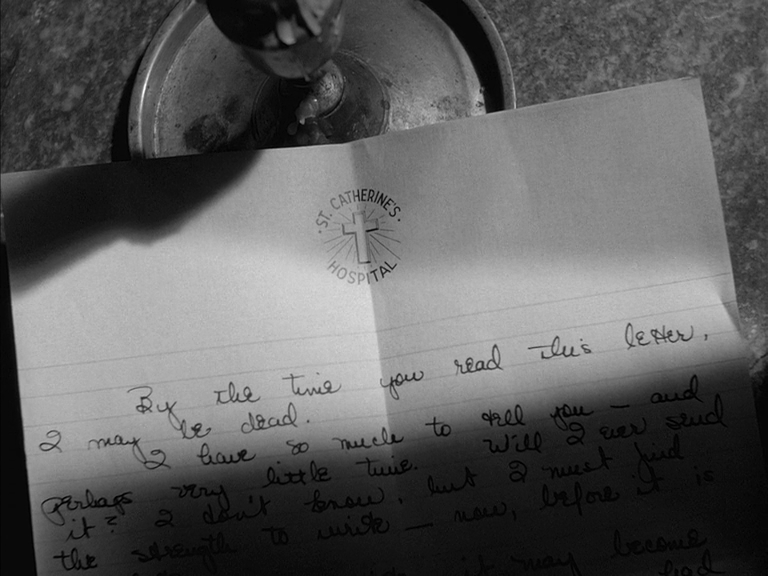
Included in this series. 1. Review (2003) Stefan (Louis Jourdan), a concert pianist and gentleman dandy in turn of the century Vienna, arrives home after yet another evening of dissipation. His mute servant hands him a letter. It is from a woman, and its first words well and truly halt him in his tracks: "By the time you read this, I will be dead." What unfolds from this extraordinary opening has more than a fair claim to be not only the best film of director Max Ophüls, and a supreme achievement in the often unfairly maligned genre of melodrama, but also one of the greatest films in world cinema history. It is, in its own terms, one of the few movies that deserve to be rated as perfect, right down to the smallest detail. Superbly adapted from Stefan Zweig's novella by Howard Koch, this is the apotheosis of doomed-love fiction. Flashing back to trace the hopeless infatuation of young Lisa (Joan Fontaine) for Stefan, Ophüls gives us a vivid, heartbreaking portrait of a love that should never have been: her naïve romanticism of artistic men mismatched with his indifferent objectification of available women adds up to gloomy tragedy. Ophüls' intuitive grasp of the inequity of gender roles in 20th century Western society is still breathtaking in its insight. Ophüls constructs a most exquisitely poised work. While encouraging us to identify with Lisa's longing, and the dreams of a whole society fed by its popular culture (a mobile scenic backdrop standing in for a later era's movies), the film at the same time provides a trenchant and devastating critique of the myth and ideology of romantic love. Our understanding of the tale hinges on its delicate shifts in mood and viewpoint. Relentlessly and hypnotically, Ophüls' mise en scène strips away the veils of illusion that enswathe Lisa and, indeed, so many seemingly similar Hollywood love stories. Either the staging reveals shows the banal conditions of reality that underwrite these flights of fantasy, or the camera suggests, in subtle positionings and movements slightly detached from the story's world, a knowing perspective that eludes the characters. The film is a triumph not just of meaningful, expressive style, but also of purposive narrative structure. With the aid of a poignant, pared down voice-over narration from Lisa, decades are bridged and key years artfully skipped thanks to a patterning of significant details arranged as motifs, concentrated in repeated gestures (such as the giving of a flower), lines of dialogue (references to passing time are ubiquitous) and key objects (the staircase leading to Stefan's apartment). By the time Ophüls reaches a Hollywood staple – the ghost-like apparition of young Lisa at last conjured in Stefan's memory – the cliché is gloriously transcended, and tears overcome even those modern viewers who resist such old-fashioned soapies. This is an inexhaustibly
rich film, one that has drawn cinephile after cinephile to attempt to
unravel its themes, patterns, suggestions and ironies. But no amount of
close analysis can ever extinguish the rich, tearing emotion that this
masterpiece elicits. 2. Transcript of an Unknown Session (2023) On 29 August 2023, the USA website project Galerie invited me to be the talking – or rather, typing – head for a presentation/discussion of Letter from an Unknown Woman. Below is an edited transcript of that session, originally delivered in short text fragments online in real time to a live audience of subscribers (as well as answering their questions), and interspersed with screenshots and clips; I reproduce it here because, by 2026, Galerie appears (like so many quasi-streaming ventures these days) to have bit the dust, and nothing of its fairly extensive archive remains online. A friend hypothesises: “It was owned by billionaire Steven Rales, who bought Criterion [in May 2024]. So I assume now that his company [Indian Paintbrush] has a more famous niche streamer, it was shut down.” Hi, I’m Adrian Martin, I’ve been a film critic, teacher and writer for many years, and since first seeing Letter from an Unknown Woman on a black & white TV in my teenage days, I’ve been totally hooked on the work of director Max Ophüls. One of the first long articles I ever wrote was about him – about the critical debates around his work happening in the 1970s – when I was just 20 years old. I did three feature-length Ophüls commentaries in 2009-2010 for the Australian DVD company Madman (they are rare items today, try eBay). And, more recently, I provided the audio commentary for Kino Lorber’s 2023 Blu-ray release of There’s No Tomorrow/Sans lendemain (1939) – another fantastic (and generally underrated) Ophüls film, one with many connections to Letter from an Unknown Woman. When you’re up for the intensity of the experience, I suggest a double bill! Ophüls (1902-1957) did not have an easy career, although his final 1950s French period (Madame de …, La Ronde, Le Plaisir, Lola Montès) was his most successful and acclaimed. Before that, however, the political events of World War II had him and his family on the hop from country to country, and he made films wherever he could. His son is Marcel Ophüls, who became a very significant political documentary filmmaker: The Sorrow and the Pity (1969), Hôtel Terminus (1988), and so on. He did a lot to keep his father’s legacy alive. [Note: Marcel died in 2025 at age 97.] Ophüls
spent much of the 1940s in Hollywood, but there were many unmade
projects, and necessary compromises on some that he did get to make.
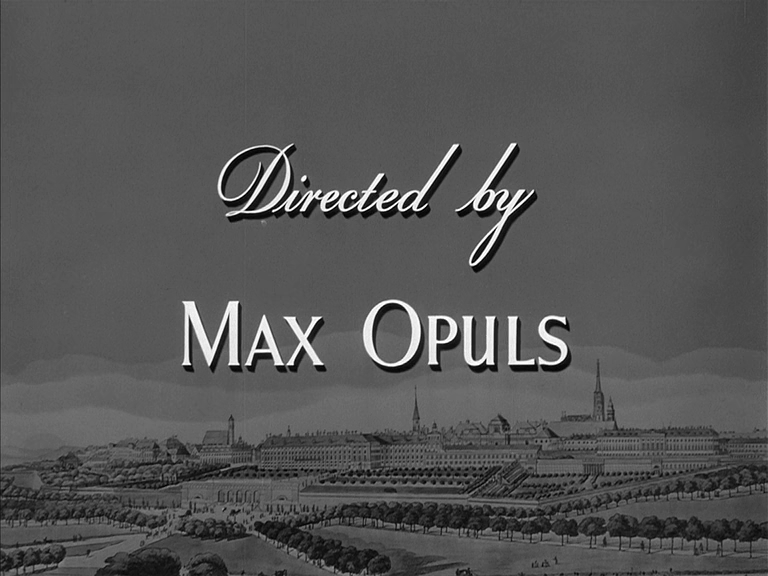
They even changed his name to ‘Opuls’ for a while, as you can see
in the credits of Letter from an Unknown
Woman!
However, there are, for me and for many cinephiles, two indisputable masterpieces from his American sojourn: The Reckless Moment (1949) and Letter from an Unknown Woman. It took a few decades for the latter to be truly recognised as the masterpiece it is. It received some mild praise on its initial release in 1948, and it became a popular staple of television programming in the 1950s (which pleased Ophüls greatly). For a long time, however, it was regarded (in a dismissive, pejorative, flip way) as merely a melodrama – and even more specifically, a ‘women’s weepie’. Starting in the early 1970s (long after the director’s death), film lovers started to take both things – cinematic melodrama, and stories of women’s experience – far more seriously. Melodrama is the realm of heightened emotion – and a heightened filmic style to convey that emotion, including the soundtrack music (melodrama means, literally, ‘music drama’). In terms of narrative, melodrama makes flagrant use of supposedly unrealistic devices like coincidence, chance meetings … Ophüls understood and embraced all this; he really was someone who joined (assumed) high and low cultural forms and narratives in a totally unselfconscious way. You have to take his films directly at that level, without snobby qualification or smug irony, to appreciate their intensity and emotion. This is true of much great popular cinema! Another widespread perception that dogged proper appreciation of Ophüls’ films was the notion that they were just superficial – whimsical, frivolous, lightweight. Some prominent American and British movie critics were still (incredibly enough) saying that in the 1960s. Ophüls had already planted the rejoinder to it inside Madame de… in 1953, where he has a character say that certain things are “only superficially superficial”. In fact, I, among many others, have come to see that his best films are truly profound – so multi-layered, and enduringly modern in their outlook. He liked to present himself, in writings and interviews, as a lighthearted, eccentric, whimsical fellow. But he was a perfectionist – a sometimes frustrated, exasperated perfectionist – with an incredible knowledge of all the arts (he began in the theatre, briefly acting and then directing), and the bearer of a vision all his own. Letter from an Unknown Woman, brilliantly adapted by Howard Koch (1901-1995) – and incorporating many ideas contributed by Ophüls – from a novella by Stefan Zweig (1881-1942), creates a complex perspective for us as viewers. Zweig’s story is almost entirely Lisa’s first-person narration as written in her letter – parts of which are beautifully woven into the film. But Ophüls’ genius lies in the way he both immerses us in Lisa’s romantic fantasy, and at the same time detaches us from it – especially through his use of the camera. Before I go into that camera work, it’s worth noting a major change that Ophüls insisted on from the start of the scripting process: in Zweig’s story, Stefan is a writer; Ophüls preferred him to be a piano-playing musician. The cinematic possibilities of a music-based character were greater! And it also allowed Ophüls to subtly use the dramatic/ironic counterpoint of certain classical pieces, such as Mozart’s The Magic Flute. Another
tweak in the adaptation that became an immortal moment in cinema: in
Zweig’s story, the first words of Lisa’s letter are: “To you
who never really knew me”. Ophüls and Koch came up with something
even more attention-grabbing.
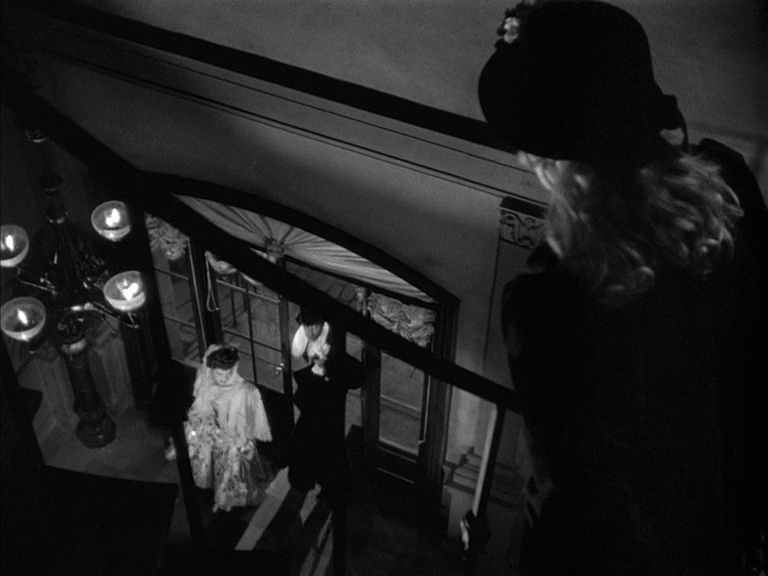
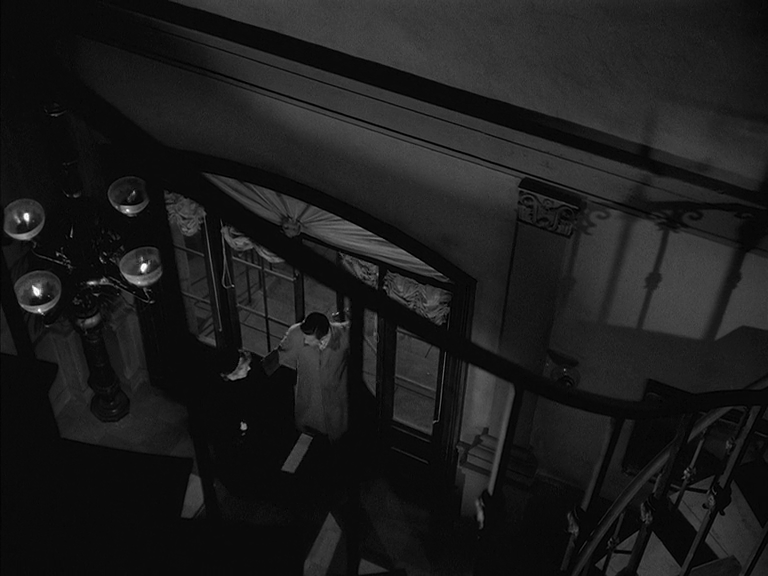
For this project, Ophüls had the opportunity to recreate – in a totally stylised way, on Hollywood sets – a world he knew well: Vienna at the beginning of the 20th century. He knew its reality, and also the romantic myth of it. The critic Jacques Lourcelles remarked: “Ophüls was never more himself than in this Vienna admirably reconstituted in a studio”. That’s an aspect of all Ophüls’ work: he embraced artifice, unreality, and made the most of it. Certain Hollywood conventions suited him well! Let’s now go right to the heart of the film. On many levels, it tells a love story that is tragically divided in two: how Lisa perceives and lives it (obsessively, tragically); and how Stefan perceives and lives it (thoughtlessly, casually, unfeelingly). Ophüls wouldn’t have used a phrase like ‘the social construction of gender’ in his day but, in fact, he had incredible insight or foresight into exactly this problem – and he always centred the woman rather than the man. He analysed women’s and men’s roles with extraordinary acuity. And neither gender ends up happy! As contemporary film director Karyn Kusama says [in curatorial selection notes prepared for Galerie but no longer online]: the film “critiques the devastating cost of female sacrifice within traditional romances … The film pulls back the curtain on male chivalry and female devotion, revealing both to be largely no-win exercises in self-deception”. Look
closely at the way Ophüls conveys this idea of a tragic division
between the sexes, through the repetition of a camera angle with
movement: first, when young Lisa sees Stefan enter his apartment with
one of his (many) lovers; and second, when Lisa herself – without
grasping this fact – becomes herself just another passing
‘conquest’ of Stefan’s.
Let’s
credit a great cinematographer here, too: Franz (the credits
Americanise him to ‘Frank’) Planer. He also worked with Robert
Siodmak, Blake Edwards, William Wyler and other terrific directors.
Yet another Austrian émigré who made his way to Hollywood in the
1930s. Here is just one screenshot that captures the work Planer &
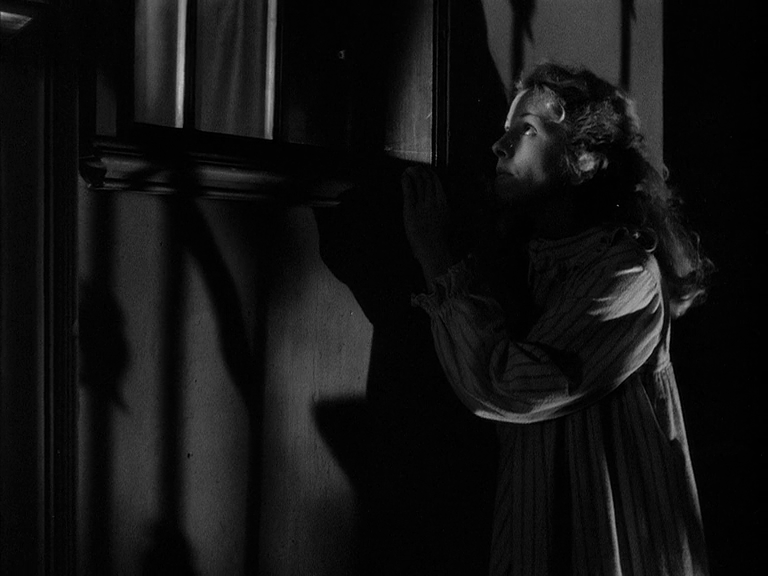
Ophüls did with light and shadow, as Lisa listens surreptitiously to
Stefan playing the piano.
I’ll also note a remarkable art director/production designer: Alexander Golitzen (1908-2005). He did major melodramas with Douglas Sirk, and the detailed, sometimes baroque look of Golitzen’s design is evident in everything he worked on, including an underrated Doris Day thriller, Midnight Lace (1960). Back to the central characters of Letter from an Unknown Woman. Lisa is a fascinating figure in this tale, and Joan Fontaine does an amazing job of bringing her to life in the different age/time periods, from teenage innocence to at-death’s-door. She was 30 at the time, and the only moment her and Ophüls clashed on set was when he once complained that she was “behaving like a star” – and she was a star! The film does not forgive Stefan or let him off easily, but neither does it paint him as just a one-dimensional, pathetic cad. He does have moments of sensitivity, of real longing for a deeper connection with somebody … and he does accept his final probable death sentence! The circumstances that lead to Stefan’s ultimate likely fate indicate another dimension that is present in many Ophüls films: there is the sphere of high romance, but there is also a real world in which people make arrangements for the sake of survival or money. Marriages, for instance, are often not terribly romantic in Ophüls: they are pragmatic (we see the same thing in Madame de … ). They stand for everyday life, a compromise with the world. No-nonsense mothers in Ophüls tend to arrange such marriages! From
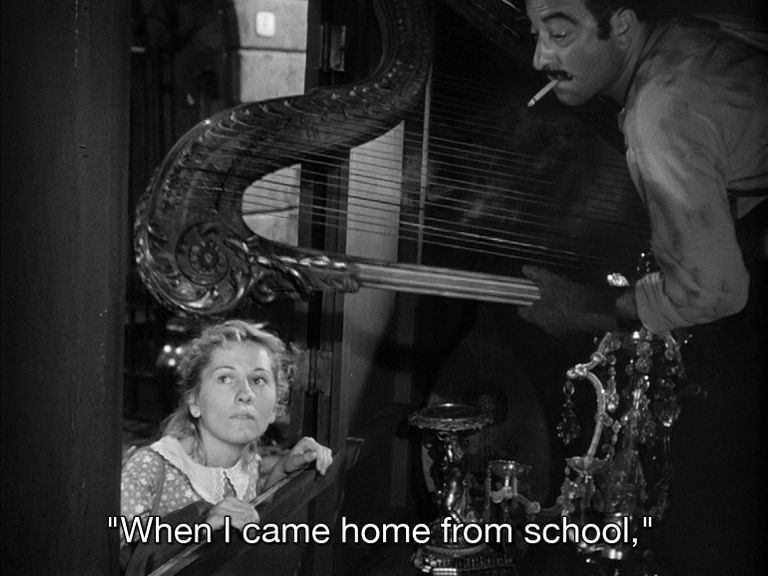
the very beginning, Ophüls insists on the almost vulgar concreteness
of the real, everyday, unromantic world – and its distance from
Lisa’s fantasies. This is how we first see Lisa, dwarfed by a very
practical piano-mover.
Sometimes the core of the drama in Ophüls is that this pragmatic world is, finally, very fragile: the mad dream of love, when it arises or returns, can smash the everyday world to pieces. It’s a catastrophe, with, usually, literally fatal consequences. The death toll is high in Ophüls! Here is a famous scene in which Ophüls both immerses us and distances us in the situation of characters – by gently unmasking the illusion of it all. Another crucial structuring theme. Lisa expresses her own belief in the mythos of romantic love by constantly evoking Fate or Predestination: to paraphrase, ‘it could only ever have been this way, it was our shared destiny’. But when Ophüls takes us out of her internal world, he lets us see a much more random world, with many layers of activity, and many possible destinies. That’s why there are so many ‘workers’ behind the scenes’ shown in his films: servants, labourers, assistants, bureaucrats, and so on. Ophüls’ camera is always peeking beyond the limits of Lisa’s closed-vision of Destiny and Fate. Among
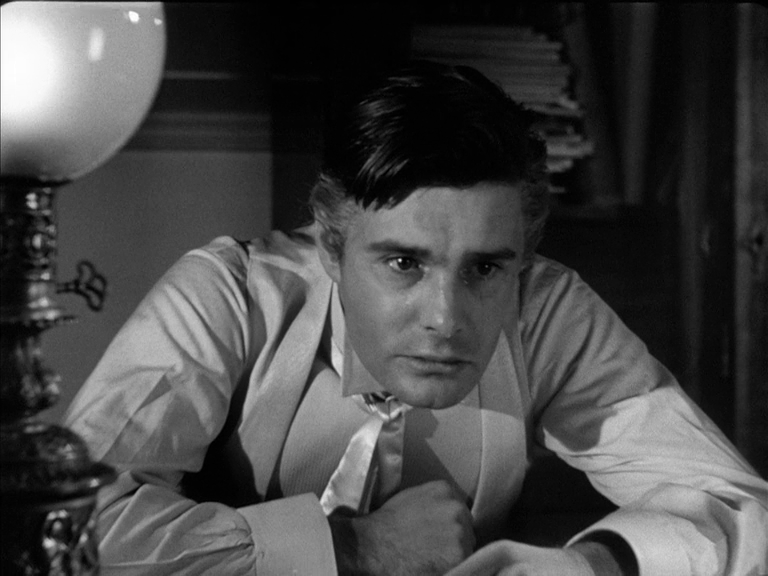
the film’s greatest moments is when
Stefan finally looks up from reading the letter, and we see on his
face the force of, at last, total realisation. Rarely has a blast of
intense Hollywood movie music (by Daniele Amfitheatrof) been so
effective as here!
Part of the magic of this moment is the counterpoint that Ophüls has built up, across all the Stefan scenes, between him and his mute servant, John (Art Smith): the person who doesn’t speak, but has always seen and known everything – whereas Stefan lives his days and nights blithely, knowing nothing until the end! That’s the kind of pointed comparison Ophüls loved to include; it is not in Zweig’s original story. Ophüls in Hollywood sometimes had to fight to get the scenes done exactly as he wanted them, both in filming and then in editing and sound mixing (his intentions were always very precise). There is a brilliant book by Lutz Bacher that went into the studio archives to find out every possible detail of this constant negotiation process: Max Ophüls in the Hollywood Studios (1996). I highly recommend it. Here is a scene where Ophüls did not entirely end up with what he, at first, wanted. The film’s producer, John Houseman, a very sophisticated fellow who also collaborated with Orson Welles and Nicholas Ray (he became a highly recognisable actor later in life in The Paper Chase, both the 1973 movie the subsequent TV series), tells the story behind this scene. Ophüls set it up do the entire first part of the scene, on the ground floor and then going up the stairs, in just one, long, mobile take, a sequence shot. Houseman was concerned it wouldn’t work doing it that way, and so he insisted on Ophüls doing two extra shots (one each on Fontaine and Jourdan) to eventually break up the sequence-shot in editing. At that precise moment, Houseman says, he became the “mortal enemy of Art” that Ophüls believed every movie producer to be! But very reluctantly, Max did film those extra shots. Two days later (after no words had passed between them), Ophüls invited Houseman to watch the edited scene – with a shortened sequence-shot plus the two inserts – and as Houseman left the room, Ophüls called out: “I’m glad I’ve got those close-ups, Tschon!” – Tschon being his way of pronouncing John. After that, they remained close friends to the end of Ophüls’ life in 1957. I have mentioned how Ophüls uses repeated camera angles to express a unique perspective on the story. In fact, the entire film is structured, at script level, upon repetitions, variations, reprises, recurring motifs like in music: scenes on train platforms, at concert recitals, in streets … Ophüls was a master at creating meaningful irony in a film narrative, on every possible level. The careful repetitions bring out this irony in many shades: humorous, tragic, sympathetic, critical … Who did Ophüls influence in cinema history? I have to respond that there is no other filmmaker who does exactly what he does, or mimics him all that well! The mixture of sensibility, style, irony, the particular casting and direction of actors: that’s unique to him, and maybe also to the times and circumstances he worked in. But there are scattered traces of his influence on many subsequent filmmakers: Stanley Kubrick, Bernardo Bertolucci, Sally Potter, François Truffaut, Todd Haynes, Leos Carax, Paul Thomas Anderson, Stanley Kwan, Paul Vecchiali … For anyone who wants to go deeper into all of this, there is a lot of good stuff written on Ophüls, and on this particular film. In fact, you can trace the entire development of serious film criticism through studying the changing approaches to Letter from an Unknown Woman! The British critic Victor (or V.F.) Perkins spent literally his entire adult life returning to it. Robin Wood wrote about it in the mid ‘70s. Brilliant feminist scholars including Tania Modleski, Mary Ann Doane and Laura Mulvey have mined its complexities. Tag Gallagher has a video essay about it on the Olive DVD edition. The American philosopher Stanley Cavell based his idea of the ‘melodrama of the unknown woman’ on it (in the 1996 book Contesting Tears). And at least one video artist (Thierry Kuntzel) has made an art installation (Nostos I in 1979) using fleeting fragments from its soundtrack, set to his own electronic images. Because it’s a film about time, memory, identity … and can lead to many reveries on these themes. As you can no doubt tell, this is a film I can talk about forever. By the way, there are other versions of Letter from an Unknown Woman, which draw both from Zweig and (inevitably) from Ophüls: a rather clunky 1952 live TV play which can be found on YouTube; an Egyptian film of 1974; a modernised French version in 2001 starring Irène Jacob, directed by Jacques Deray and scripted by Jean-Claude Carrière; and a good Chinese adaptation directed by Xu Jinglei in 2004, which is, at last, a female director’s version of this classic ‘weepie’ material. I am very happy to report that tragic-romantic melodrama lives on! I will end with a quotation. Although, in general, it took a long time for critics worldwide to really appreciate Ophüls, some of his contemporaries were at least on the right trail. When François Truffaut and Jacques Rivette of interviewed Ophuls in 1956 (not long before his death) for Cahiers du cinéma, they offered this introduction: He is as subtle as people think he is crass; as deep as people believe he’s superficial; as pure as people believe he’s dirty. A cruel painter, he treats only the eternal, most essential subjects: desire without love, pleasure without love, love without reciprocity. Desire without love, pleasure without love, love without reciprocity! What a recipe for tragic melodrama, fully on display in Letter from an Unknown Woman. Bye
for now, and thanks everyone for attending (or later reading) this
session. I hope Galerie can invite me back sometime! © Adrian Martin April 2003 / August 2023 |