 |
 |
 |
 |


|
|
|

|
To Have and to Hold
|
 |
|
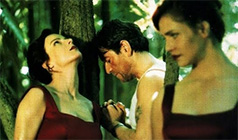
Introduction 2025: In late 1996, I was standing forlornly in the corner of some film-scene party in Melbourne, when a stranger dashed over and whispered in my ear: “Watch it – John Hillcoat is coming toward you”. This meant only one thing: that the director had heard, on radio (12 October 1996), the review published below (of a film that is, these days, not so easy to find – its last DVD release was in 2007). I feared the worst, like a punch in the face or a drink emptied over me, when John shot out his hand and said: “I would like to meet you. You didn’t like my film, but you got what we were trying to do, and you told the truth as you saw it”. Nine years later, I was overjoyed to welcome his superb The Proposition (2005) into the world, and to closely follow his subsequent, international career. The TV miniseries he wholly directed, George & Tammy (2022), is especially impressive. There will surely be much more great work to come from this director. PS: I am even leaving in this review my awful, concluding salvo about Scott Walker (1943-2009), whose ‘late style’ of music I later came to adore! John Hillcoat’s To Have and to Hold is straightforwardly a disaster. Hillcoat is an intriguing figure in the context of Australian cinema, one of our few truly cosmopolitan filmmakers. He hails, in part, from the world of ambitious 1980s music video; his first film, Ghosts … of the Civil Dead (1988), was a raucous, disconcerting, jagged collage, with Nick Cave creatively in tow. From the word go, Hillcoat has been mixing up traces of various cultures in his work – and he is also uncommonly sophisticated in his references to other films and filmmakers. With To Have and to Hold, he draws upon a great, and sometimes subversive, Hollywood tradition: the tradition of tough, romantic melodramas about desire and obsession, entrapment and psychological blindness. This is a tradition that incorporates everything from Alfred Hitchcock’s Rebecca (1940) and Vertigo (1958) to Douglas Sirk’s The Tarnished Angels (1957) and, outside Hollywood, the darkest films by Michael Powell (with or without Emeric Pressburger), such as Black Narcissus (1947) and Peeping Tom (1960). So: Gothic romances, in the main. And Hillcoat tries hard to work up a hot, expressionistic style to suit such a melodrama – especially in collaboration with cinematographer Andrew de Groot, who does his usual splendid, sometimes visionary work. How on earth, then, does this brave, bold, technically highly-achieved effort fail so badly? To Have and to Hold starts from a Rebecca-type premise. In the giddy first minutes, we see a hulking, soulful, white, French guy in New Guinea, Jack (Tchéky Karyo). He’s plunged into a terrible ritual of mourning over his recently deceased wife. Then, suddenly, he’s in an Australian metropolis; through a shop window, he gazes upon his Dream Woman, Kate (Rachel Griffiths). He’s besotted and woes her, and she responds to this whirlwind courtship by jetting back to New Guinea with him. In these first few minutes (things move fast here), Hillcoat has dared to leave behind most signs of conventional psychology and character interaction. These people don’t define or announce themselves through mere words; no, they are pure beings of cinema, all eyes and looks and bright, red dresses, sighs and screams and sweating flesh. In many other movies, I could easily go along with this approach. Indeed, I might easily love it, and want to dearly defend it against naysayers, if it were a film by Werner Schroeter or Daniel Schmid. But To Have and to Hold is a movie that seriously never touches the ground – and the level of fantasy on which it plays out seems to me like an over-heated, adolescent ideal of what a primal, lacerating drama should be. Hillcoat is the local soul brother, in this regard, to Geoffrey Wright and his Aussie catastrophe of the previous year, Metal Skin (1995). I tend to blame a particular American, Francis Ford Coppola, for these airy excesses in Australian cinema – the Coppola of Apocalypse Now (1979/2001). And maybe also the Stanley Kubrick of Full Metal Jacket (1987). Like Coppola’s film, To Have and to Hold stages a story of a white man’s psychotic crisis against the florid, exotic backdrop of an indigenous culture. In this case, it’s a portion of New Guinea, disintegrating and ransacked because of its young raskol gangs. The glimpses we get of this prevalent lawlessness and anarchy function like the shots of indigenous people butchering animals at the climax of Apocalypse Now: this weird, florid, savage culture provides the filmmaker with some handy visual metaphor for the dark violence in all our hearts … that sort of trip. As I watched, I found it hard to fight down the thought that it is casually racist. To be sure, ‘racist’ is a term of critical abuse used rather too loosely and reflexly these days. On the level of its obvious intentions and themes, To Have and to Hold is clearly not some racist, white supremacist tract – in fact, it’s trying to be absolutely the opposite of that. The script (by Hillcoat and Gene Conkie) sets up two mirroring subjects: the delusions, projections and power games that are involved in romantic love; and the delusions, projections and power games involved in white, colonial rule. This comparison between two kinds of oppression is very clumsily handled. But what’s far worse is that the film never seems to get outside such mad visions of power; it is unable to give us a detached, critical perspective on either personal or public politics. Now, I don’t always want films to be detached: I adore certain movies like Bad Lieutenant (1992) or Casino (1996) that plunge you right into the compulsive obsessions of their anti-heroes. What’s irksome about To Have and To Hold, however, is that the behaviour it wants to criticise is also the spectacle it adores, in an almost sick and infantile way. Hillcoat – it would seem from this evidence – adores the spectacle of mania, oppression and social breakdown, just as Kubrick relished the moment in Full Metal Jacket where a young Vietnamese woman with a machine gun is revealed in all her over-charged, near-demonic splendour. The way To Have and to Hold overworks its spectacle side has terrible repercussions on the actors. I don’t believe that either Karyo or Griffiths give bad performances; but they do look like they are struggling with absolutely impossible parts. Karyo has to look dogged, haunted, doomed, sunken and tragic for almost the entire proceedings; Griffiths has to flit from innocence to experience, from hysteria to calm, with hardly a beat in-between to make any of these psychological changes or modulations work or flow. Actually, there is some attempt at detachment or critical distance in To Have and to Hold. It comes through the use of irony. Alas, I have rarely seen ironic devices used so heavy-handedly. Kate, for instance, happens to be a romance novelist; so that means, as the reality around her begins getting uglier, that she’s still writing reams of purple Mills & Boon-ish prose which we hear on the soundtrack – odes to Jack’s “velvet touch” and whatnot. Jack, for his part, has his private videotapes – tapes of his late wife, cavorting drunkenly in her melodramatically red dress. The film spends far too much time with Jack holed up mad in his den staring myopically at these tapes. Even worse, the mystery element of the plot is tied up with what’s on them. The revelatory moment of truth that we finally see there is especially badly handled. And finally, in this list of heavy-handed ironic devices, there’s a song. Unhappily for me, it’s a song I happen to love, Bob Dylan’s beautiful, understated 1969 lament “I Threw It All Away”, fit for a Terrence Malick movie. This song plays as a stern counterpoint in To Have and to Hold, since – you guessed it – Jack is that sad man who is, before our eyes, throwing it all away! To heighten the thick, excruciating irony of it all, we get a peculiar cover version of the song produced by Nick Cave and arranged by Barry Adamson – and sung by the celebrated Scott Walker. Despite that undoubted ledger of musical talent, the track comes over like a demented piece of Muzak, a “velvet voice” drowning in soupy strings. What a concept! Where in Shirley Barrett’s Love Serenade (1996) – released the same week in Australia – there are around a dozen songs, with a few select repeats, To Have and to Hold gives us this one maddening song, obsessively, compulsively replayed, from start to end of the film. Oh, the horror, the horror! © Adrian Martin October 1996 |


